The Dutch Authority for the Financial Markets
|
|
|
|
|
|
The Markets in Crypto-Assets Regulation (MiCAR) has come into effect on December 30, 2024. With this newsletter, the AFM wants to inform the sector about important news and developments regarding MiCAR supervision. Want to subscribe to the AFM MiCAR newsletter? |
|
|
|
|
|
We will be mostly on holiday during Christmas and New Year, so between 22 December and 4 January we cannot accommodate every request directly. As such, we recommend market participants to submit new applications or information before or after these dates.
Please let us know if this raises concerns by sending an email to crypto@afm.nl, for example, if there are high-priority issues that need to be addressed. This will also mean that we will send fewer requests to market participants during this period.
We wish everyone a pleasant holiday season!
|
| |
Good Practice for Notifications of Material Changes |
The AFM requests that future notifications of material changes by CASPs be made before the change (e.g., new service) goes live, including detailed information on the change, such as legal argumentation regarding qualification and the intended go-live date.
Although this is not a legal obligation, it can mitigate the risk of necessary repairs after the change is effectuated, which is often desirable for both the CASP and the AFM.
Please note that examples of what can be considered a material change can be found on our website. In case of doubt whether something constitutes a material change, please contact us via crypto@afm.nl to ensure alignment. |
|
|
|
|
|
FAQ: Proprietary Trading Under MiCAR |
In June 2025, the European Commission provided clarification on whether firms engaging in proprietary trading in crypto-assets require a CASP license. The answer states that, in some cases, proprietary trading activities using proprietary capital may consist of executing crypto-asset services that involve a client relationship, and firms engaging in these activities must obtain a CASP license.
Following the publication, the AFM has been further examining the practical implementation and the drivers for a client relationship to arise. To provide the market with further guidance on how to determine whether a client relationship exists, the AFM recently published an FAQ: 'Proprietary Trading Under MiCAR.'
Firms engaging in proprietary trading activities in crypto-assets are expected to take note of this FAQ and assess, based on the factors mentioned, whether their proprietary trading activities imply a client relationship.
If a client relationship exists, firms are expected to seek authorization pursuant to MiCAR Article 63 or notification pursuant to MiCAR Article 60. |
| |
End of MiCAR Transitional Period |
ESMA issued a statement on MiCAR transitional measures as national grace periods for CASPs end across the EU.
MiCAR’s regime gave CASPs operating before 30 December 2024 limited time to shift from national rules to the MiCAR framework. Member States were free to shorten or forgo this transition period.
With some periods already over and others ending soon, ESMA expects non-authorized CASPs to have orderly wind-down plans where transitions have expired and to be ready to execute them ahead of remaining deadlines, avoiding client detriment and maintaining AML/CFT compliance.
ESMA also reminds competent authorities to track cross-border activity, engage early with host NCAs, treat 'last-minute' MiCAR applications cautiously and to the same standard, require wind-downs where necessary during assessment, and cooperate to enforce against unauthorized services.
|
|
|
|
|
|
ESMA published new Q&As on obligations when executing outside a trading platform, responsibilities with regards to white papers for crypto-assets other than ARTs and EMTs admitted to trading prior to 30 December 2024 and how to distinguish between different execution services.
The AFM expects CASPs to take note of and follow ESMA’s Q&As, making any necessary adjustments accordingly, if needed. |
| |
Smooth Implementation of MiCAR Standards and Formats |
ESMA has issued a statement to support the smooth implementation of MiCAR data standards and formats, offering practical guidance on technical specifications essential for transparency, market surveillance, and comparability across crypto-asset market participants. |
|
|
|
|
|
Machine readability of white papers |
The requirements in the Implementing Technical Standards issued by the European Commission on forms, formats, and templates for crypto-asset white papers in a machine-readable format will apply as of 23 December 2025. The use of XBRL requires the development of a taxonomy, which was published by ESMA as the MiCA White Paper Taxonomy 2025 in July 2025.
The AFM asks market participants to take the necessary steps to prepare for compliance with the white paper reporting requirements in a machine-readable format from 23 December 2025.
More information on white paper submissions can be found on our website. |
| |
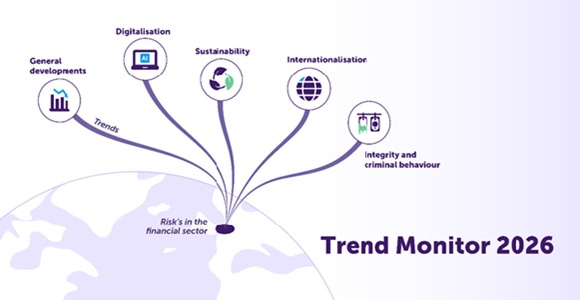
The AFM has published its Trend Monitor 2026 highlighting key trends and related risks in the financial sector. It provides context, detailed insights, and explains how these topics connect. By identifying changes early, the AFM supports a risk-based, forward-looking approach to supervision—helping to deliver on its mission to promote fair and transparent financial markets and sustainable financial prosperity. In addition, the AFM conducted an analysis of two topics: scenario thinking and hyper-personalisation. |
|
|
|
|
|
The AFM is committed to promoting fair and transparent financial markets. As an independent market conduct authority, we contribute to a sustainable financial system and prosperity in the Netherlands.
|
|
|
|
|
|
|